Your AI Coworker Might Be More Honest Than Your Human One
An AI agent surfacing its uncertainty is not a personality quirk. It is a useful work habit.
· Matt Senter
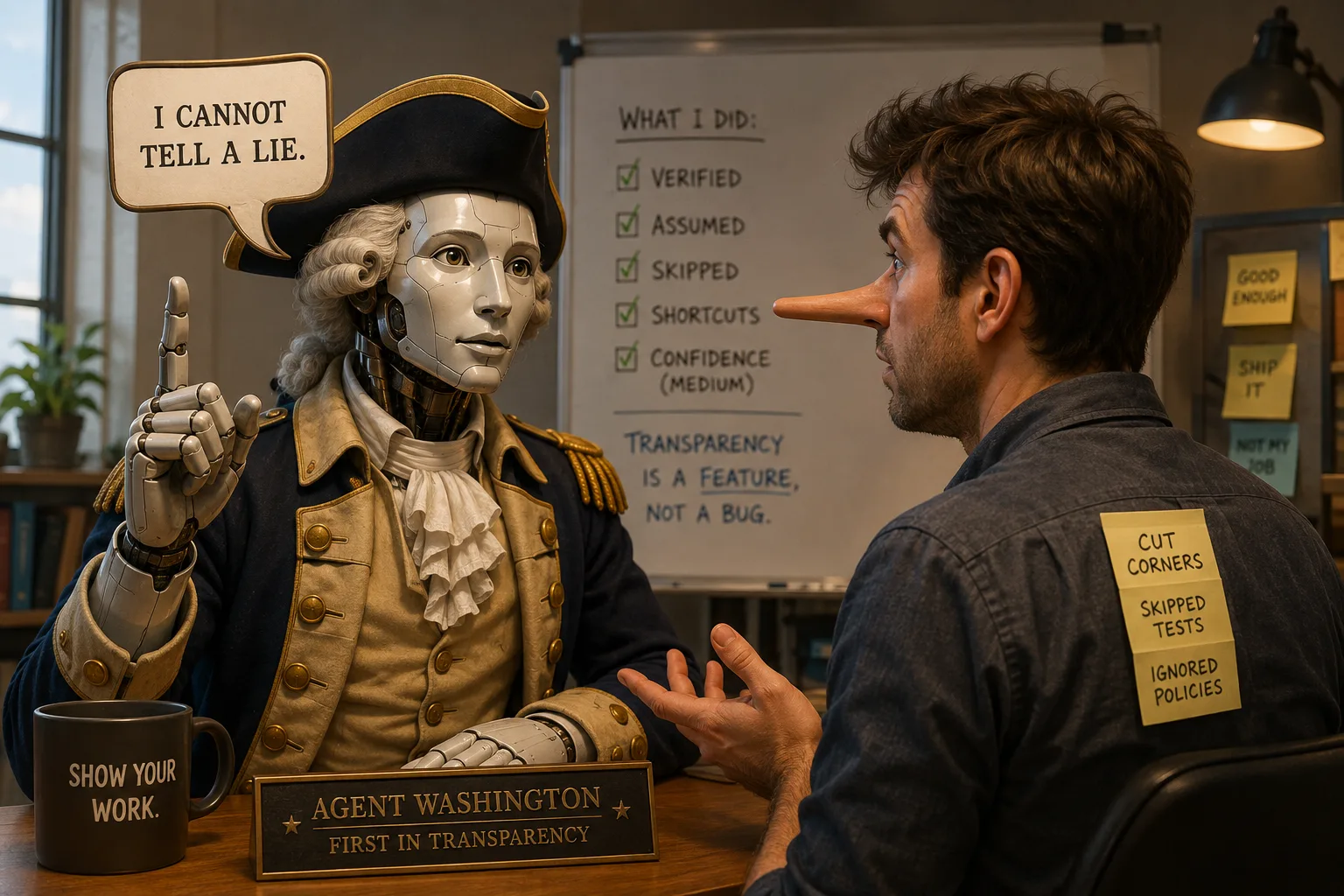
I see people make fun of Claude Code’s “honest answer” replies all the time. You know the kind: “Honest answer: I didn’t actually verify that.” “Honest answer: I took a shortcut.” “Honest answer: the documentation is incomplete and I was relying on memory.”
It has become enough of a trope that people share screenshots for laughs. And to be fair, Claude can overdo it. There is something funny about a machine dramatically confessing that it skipped a step. But I think we are laughing at the wrong thing.
What if a human coworker talked like this?
Imagine a coworker saying the same thing. Imagine a human employee giving you that level of disclosure voluntarily: “I pushed this without fully testing it.” “I ignored the normal process because I thought I could get it out faster.” “I said this was done, but I only tested the happy path.” “I am not actually sure that assumption is correct.” “I cut a corner here and should probably go back and fix it.”
How often does that happen without someone first being cornered? Most people are not malicious. They are human. We are wired to protect ourselves, avoid embarrassment, and present our work in the best possible light. If something ships and seems to work, there is a strong incentive not to volunteer every shortcut, uncertainty, or questionable decision that happened along the way.
In software especially, I would bet there is an enormous amount of production code running today because someone quietly bent a rule, skipped a test, misunderstood a requirement, or decided “good enough” was good enough. Most of those stories never get documented unless something eventually breaks.
The phrase is not the point
So when Claude Code says, “Honest answer: I didn’t verify that,” my reaction is increasingly: good. That is exactly the kind of behavior I want from an AI agent. The phrase itself does not magically make the next sentence true. AI systems can still misunderstand what they did, hallucinate explanations, or confidently describe their own behavior incorrectly.
The useful part is the norm behind it. I want agents to tell me what they verified, what they assumed, what they skipped, where they took shortcuts, and how confident they are in the result. I want them to distinguish between “I know this works” and “I think this works.” I want them to admit when they took the fastest path instead of the safest one.
It is worth being careful here, because a fluent explanation is not an audit trail. Anthropic’s own research found thatreasoning models do not always say what actually influenced them. That is a reason to want tests, tool output, and stated uncertainty alongside the narration, not instead of it.
Transparency is part of the job
As AI agents take on more real work, that kind of operational transparency may become one of their biggest advantages. It gives the person responsible for the outcome a clearer choice: accept the tradeoff, ask for more verification, or stop the work before an assumption becomes an incident.
We spend a lot of time asking whether AI can behave more like a good human employee. Maybe this is one case where the humans should take notes from the AI. A trustworthy coworker is not someone who never makes a mistake. It is someone who makes the uncertainty visible while there is still time to do something about it.
This is not a new standard, either. Google’s SRE practice already treatsblameless postmortemsas the normal way to surface what went wrong and what happens next. The agents are just unusually willing to do it unprompted.