Fix Siri
Siri runs on some of the best hardware ever made, and it still misses simple requests. Every frustrated post about it scrolls away within a day, while every keynote promise of a smarter Siri stays on Apple’s newsroom.
Fix Siri keeps both on one timeline: attributed user reports of Siri getting things wrong next to Apple’s own announcements, from the iPhone 4S in 2011 to today, each linked to its original source.
Visit fixsiri.com ↗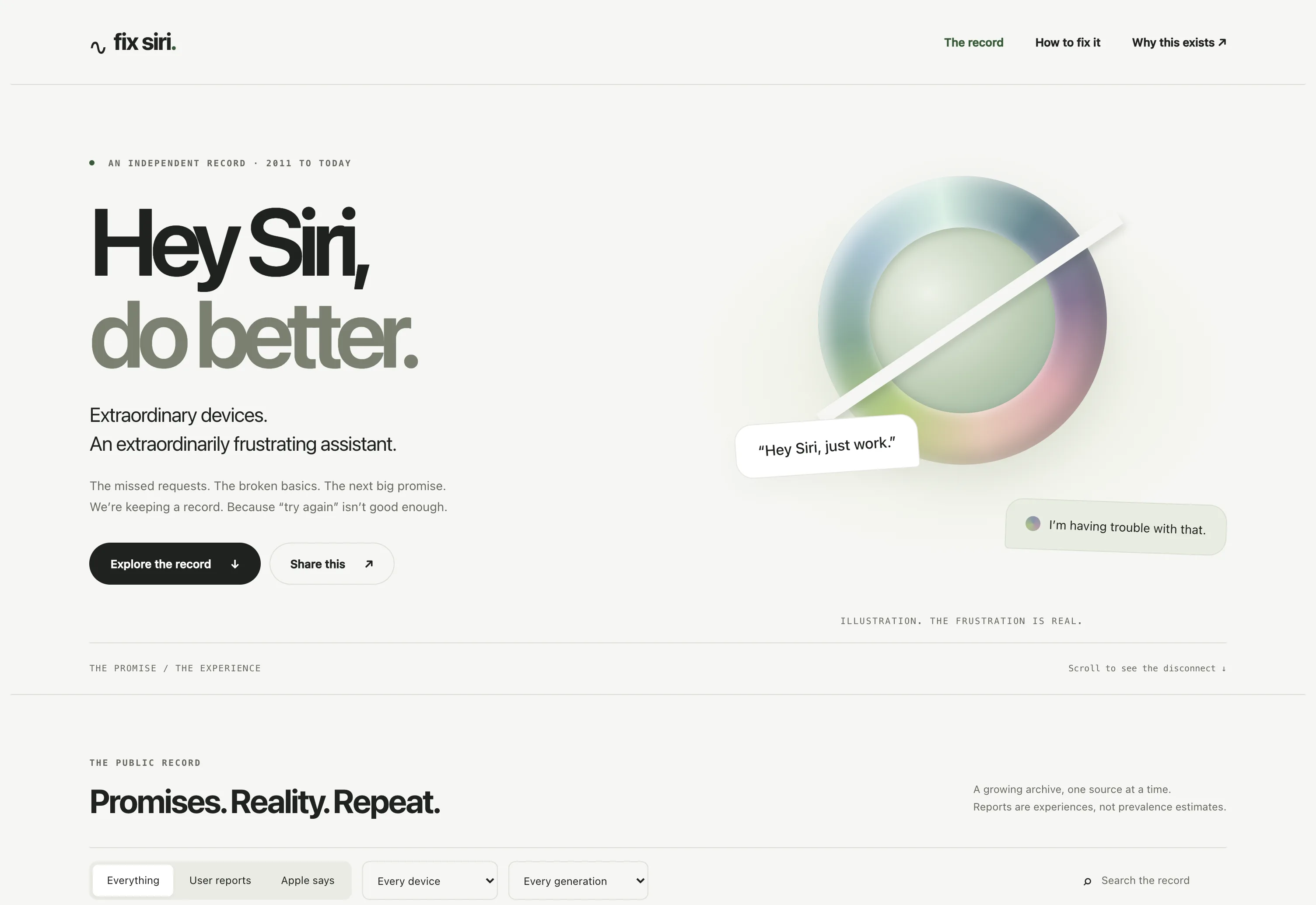
Promises next to experiences
The record mixes two kinds of entries and never blurs them. Apple announcements get their own card style and an explicit label, and they record what was announced on that date, not what shipped. User reports carry the device, the generation, and the date only when the source states them.
- Filter by device, generation, or entry type, or search the whole record
- A permanent URL and share card for every entry
- Keyboard navigation through the timeline, J and K like Reddit
Sourced or skipped
New entries are found through Brave Search, then the source text is retrieved and checked for relevance, dates, and duplicates. A separate model pass verifies the summary against the source before anything is published. Entries that fail those checks are skipped, and anything unpublished stays suppressed so it cannot come back automatically.
The archive is selective, not a survey. A pile of complaints does not establish a failure rate, and the site says so on every page that could be read that way.
Criticism with a way forward
The blog is labeled opinion and makes concrete proposals: measure whether requests actually succeed, protect everyday commands from regressions, and make one Siri behave the same on iPhone, Mac, HomePod, Apple Watch, and in the car.
Independent
Fix Siri is my own project and is not affiliated with Apple. The point is a better assistant and a clearer record, so corrections and removals are handled in the open and every entry keeps its revision history.