Highwire
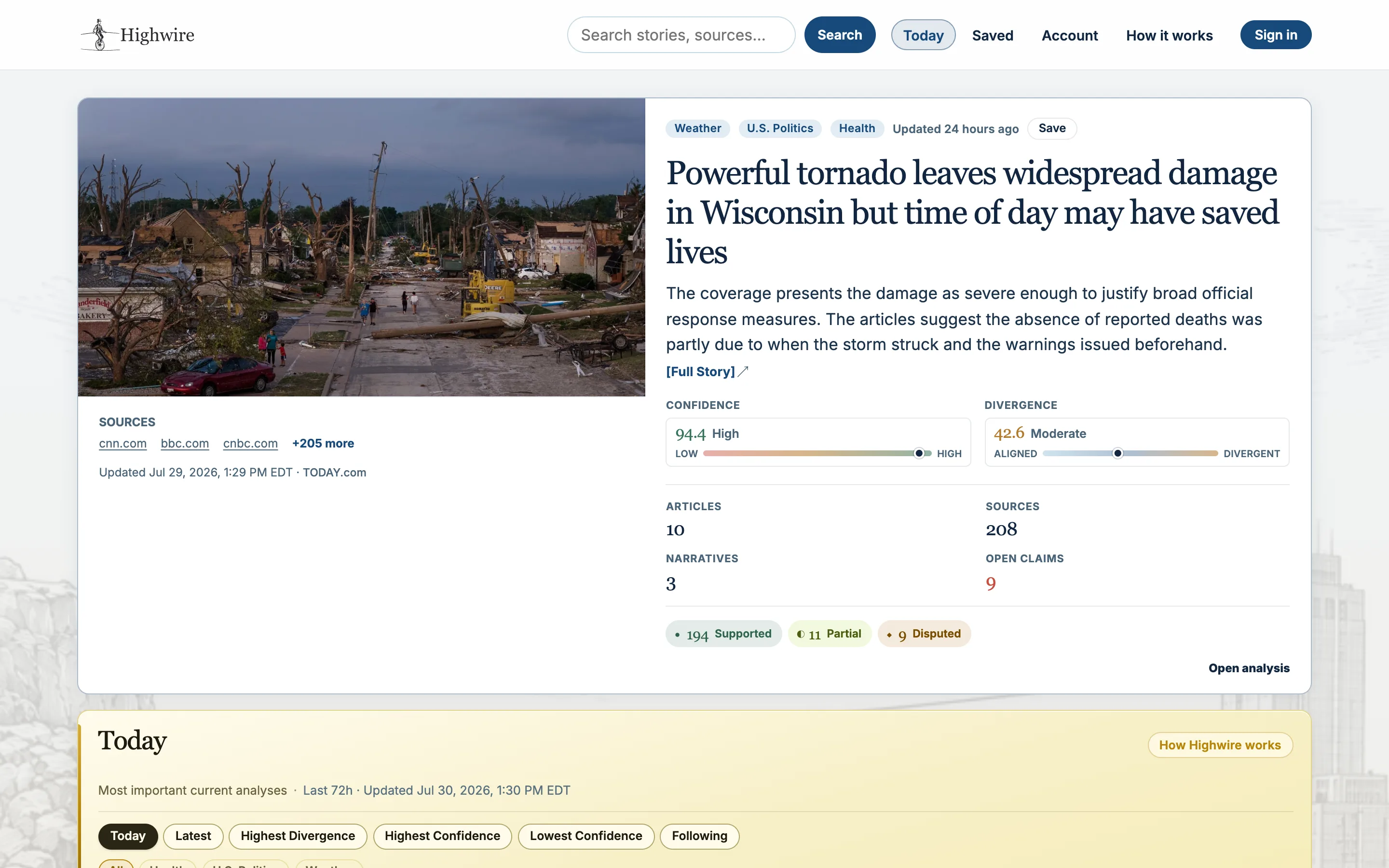
Highwire groups every article covering the same event into one story, then takes that coverage apart: which narratives are being advanced, which claims each one rests on, what evidence backs those claims, and where the sources diverge from each other.
It is not a bias meter and it does not tell you what to believe. It shows the reporting underneath the headline and links every conclusion back to the source it came from.
The problem
A headline is a summary of a summary. By the time a story reaches you it has been compressed twice, and the parts that got dropped are usually the parts that would have changed your read of it.
Reading five outlets on the same event does not fix that. It just gives you five compressions and no way to see where they actually disagree.
What it does
Highwire treats coverage as evidence to be examined rather than content to be scrolled. Each story is decomposed into the narratives being advanced and the claims that support them, and each claim is scored on how well the reporting backs it.
- All coverage of one event grouped into a single story
- Claims separated from framing, and traced to their evidence
- A divergence score showing how far the sources drift apart
- A confidence score on how well-supported the analysis is
- Every assessment one click from the source it came from
Intellectual honesty over agreement
The product is built on one principle: show the reasoning, including where it is weak or where the sources genuinely conflict, rather than resolving it into a verdict. Uncertainty stays visible instead of getting rounded off.
What reading a story in Highwire is like
You open a story and the first thing you see is not an article. It is the set of narratives the coverage is advancing, and how much of the reporting actually supports each one. Under each narrative are the individual claims, and under each claim is the reporting that backs it, or the absence of any.
The moment that made me want to build this is specific: the point where four outlets agree on a fact, one contradicts it, and every summary you read quietly picks a side without telling you it did. Highwire shows you the disagreement exists and lets you go look at it.
What Highwire will not do
It will not give you a bias rating for an outlet. Those scores flatten the thing that matters, which is that a source can be careful on one story and sloppy on the next, and they invite you to stop reading and trust the label instead.
It will not resolve a genuine conflict in the reporting into a verdict. When sources disagree and the evidence does not settle it, the product says so and leaves it open. That is a deliberate choice to be less satisfying and more honest.
And it will not tell you what to think. Every assessment sits one click from the source it came from, specifically so you can disagree with the analysis using the same material it used.