The Evolution of Automation: From Shell Scripts to AI Organizations
The technology changes, but the basic bargain does not: invest once so you do not have to keep doing the same work forever.
· Matt Senter
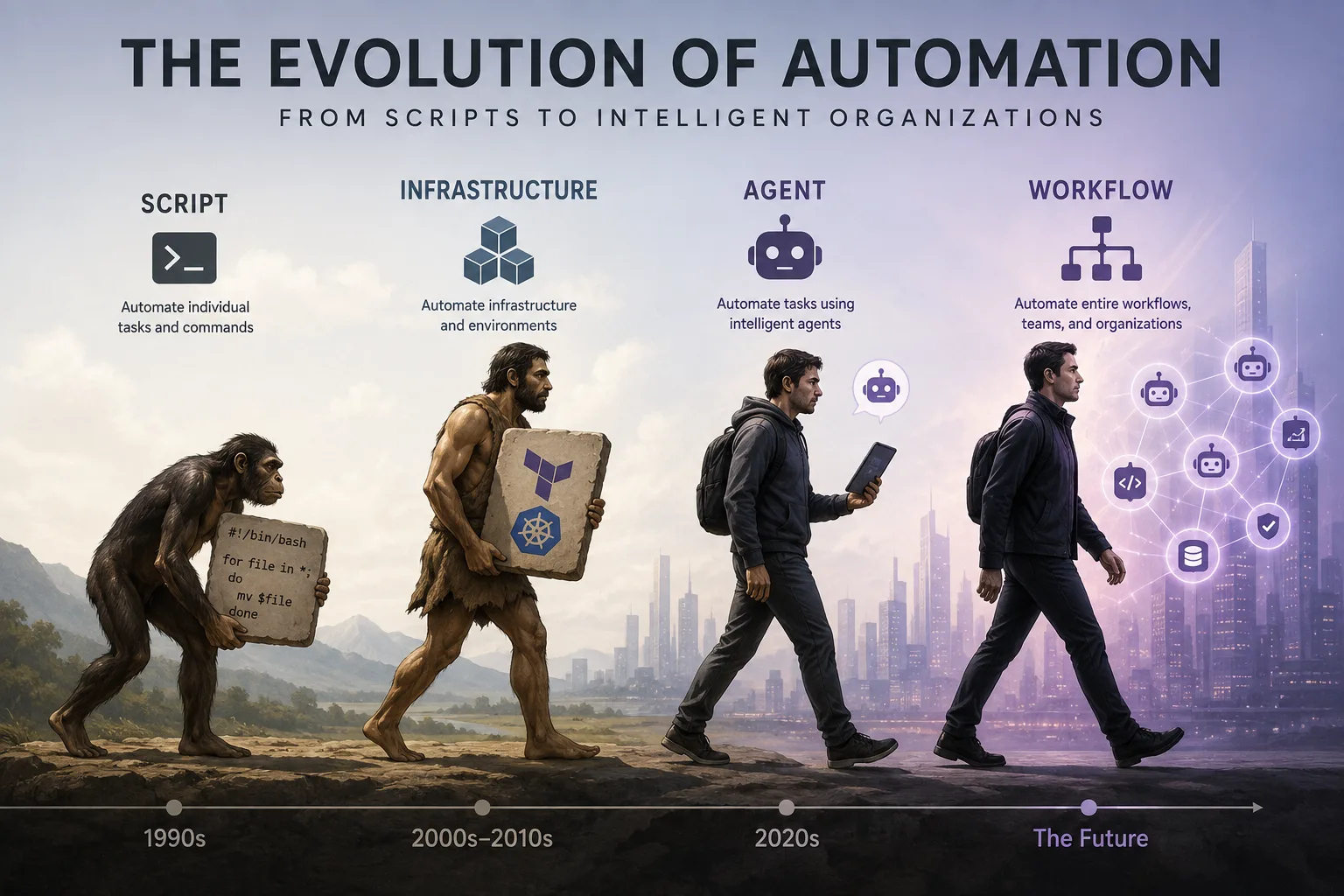
I have been building software for a long time, and one thing about automation has remained remarkably consistent the entire time: the technology changes, but the logic does not. If I find myself doing the same thing repeatedly, there is usually some point where it becomes worth spending extra time up front to automate it.
In the late 1900s, that might have meant writing a shell script. If I had to rename a bunch of files, process data in a repeatable way, copy things between systems, or run the same commands over and over, I could either keep doing it manually or spend the time to script it once. The script might take longer to create than doing the task a single time, but that was never the point. The payoff came from every repetition after that.
That basic equation has not changed. What has changed is the scale of the thing we are able to automate.
First, We Automated Tasks
The earliest forms of automation I worked with were small and local. A shell script replaced a series of commands. A cron job made something happen on a schedule. A Perl or Python script took a repetitive workflow and turned it into something repeatable.
Typical examples were things like:
- Renaming or moving large batches of files
- Processing data the same way every time
- Copying files between systems
- Running repetitive deployment commands
- Scheduling recurring maintenance jobs
The abstraction was simple: I know exactly what I want the computer to do, I can describe it precisely enough, and I would rather spend the time teaching the computer once than keep doing it myself forever. Sometimes this meant spending two hours automating a task that only took five minutes manually, which looks ridiculous if you only plan to do it once. If you plan to do it hundreds or thousands of times, it becomes obvious.
That same pattern kept repeating as software systems became more complicated.
Then, We Automated Infrastructure
Cloud computing expanded the scope of what could be scripted. Instead of automating a task on a machine, we started automating the creation and configuration of the machines themselves.
Terraform let us describe infrastructure as code. Kubernetes let us describe how distributed applications should run, scale, restart, and communicate. CI/CD systems automated how software moved from source control into production.
Suddenly, things that had traditionally required substantial manual operational work could be declared and recreated:
- Servers
- Networks
- Databases
- Load balancers
- Permissions
- Application deployments
- Scaling rules
- Entire environments
What once involved people clicking through consoles, configuring systems manually, and coordinating deployments gradually became something that could be versioned, reviewed, tested, and reproduced.
The upfront cost got bigger because the thing being automated got bigger. Good infrastructure automation is harder than a ten-line shell script. It requires more thought, more edge-case handling, more debugging, and more maintenance. The payoff, however, scales right along with the complexity. Once an environment is properly defined, entire systems that once required hours or days of manual setup can be recreated with very little human effort.
The automation principle stayed exactly the same. We just moved up a level.
Both of those layers are documented in the open. Terraform describesinfrastructure as versionable configuration with a plan-and-apply workflow, and Kubernetes describesdeclarative orchestration, scaling, and self-healing. Neither removes the design work; they move where it happens.
Now, We Are Automating Workflows
AI agents are pushing that abstraction upward again. At first, the obvious use case was to treat an agent like a very capable script: give it a task, let it perform the task, and get the result back.
That is useful, but it is also a relatively narrow way to think about what is happening. The larger shift is that we can now automate not just individual tasks, but the coordination of tasks across multiple intelligent workers.
A modern agentic workflow might look something like this:
- One agent writes the code.
- Another reviews the implementation.
- Another runs tests.
- Another checks for security problems.
- Another verifies the original requirements were actually satisfied.
- A workflow decides what happens when something fails.
- Approval gates determine what requires a human and what can proceed automatically.
At that point, you are no longer just scripting work. You are scripting the system that organizes the work. That is a much bigger jump than simply replacing one manual task with one AI task. The automation boundary is moving from execution into coordination.
Orgabot Is the Latest Version of the Same Idea
That is how I think about Orgabot. It is easy to look at AI agent orchestration and think of it as something fundamentally different from the automation tools that came before it, but at an abstract level it is the same pattern I have been using for decades.
The progression is pretty straightforward:
- A shell script automated commands I did not want to type repeatedly.
- Infrastructure-as-code automated systems I did not want to configure repeatedly.
- CI/CD automated deployment workflows I did not want to coordinate manually.
- Agent orchestration automates work I do not want to manage step by step.
- Orgabot pushes that toward automating the structure around the workers themselves.
The difference is scale. With something like Orgabot, the thing being automated is no longer a command or even a deployment pipeline. It can be a complete software-development workflow involving multiple specialized agents, permissions, review gates, verification steps, and deployment logic.
The transition is from scripting a task like “build this feature” toward defining a system that can repeatedly decide how features should be built, who should build them, how the work should be reviewed, and when it is ready to ship. That begins to look less like automating a developer and more like automating parts of an organization.
Where is automation heading next?
Looking back, the progression is remarkably consistent:
- We automated commands.
- Then we automated repetitive tasks.
- Then we automated deployments.
- Then we automated infrastructure.
- Then we automated pipelines and workflows.
- Now we are automating the workers inside those workflows.
- Increasingly, we are automating the coordination between those workers.
Automation Keeps Moving Up the Abstraction Stack. Each step moves the automation boundary upward. What is interesting is that every stage tends to feel like the top. When infrastructure became programmable, that felt like an enormous leap in abstraction. When AI agents started writing software, it was easy to imagine that we had reached the natural endpoint: just tell the AI what you want and let it build it.
But even that is already starting to look like an intermediate step. Instead of telling one agent what to do, we are building systems that decide which agents should work, how they should collaborate, how their work should be evaluated, and what should happen next. That raises the obvious question: what is above automated orchestration?
What Will Be Scriptable Ten Years From Now?
If the pattern continues, the next abstraction may be much larger than anything we currently think of as a workflow. Maybe the unit we automate becomes an entire organization.
You might describe a business goal and have a system assemble the equivalents of:
- Product development
- Engineering
- Infrastructure
- Marketing
- Customer support
- Finance
- Legal processes
- Analytics
- Operations
The input may eventually become less procedural and more intentional. Instead of specifying tasks, workflows, or agents, you might simply express a goal such as, “I think there should be a product that does this,” and the system figures out everything required to make that idea real.
There is a broader historical pattern here too. Human-computer interaction keeps moving toward higher levels of intent:
- Machine code became programming languages.
- Programming languages gained libraries and frameworks.
- Servers became infrastructure declarations.
- Commands became prompts.
- Prompts are becoming goals.
The logical endpoint is that we spend less time describing how something should happen and more time describing what we want to exist. Perhaps ten years from now, even the idea of explicitly orchestrating agents will feel primitive. Maybe we will simply express intent and let a system construct whatever combination of agents, tools, workflows, infrastructure, organizations, and processes are needed underneath it.
At the extreme, the interface may feel less like programming and more like manifestation: think of something, describe it, and watch an automated system turn that intent into something real. That sounds dramatic, but every previous abstraction layer would have sounded dramatic before it existed.
The Economics of Automation Never Really Changed
What I find most interesting is that despite all of this progress, the bargain remains almost identical to the one I made when writing shell scripts decades ago. Automation still requires an upfront investment. You have to define the process, build the system, handle edge cases, debug failures, and decide what should happen when reality does not match your assumptions.
Manual work often seems easier at first because it avoids that initial investment. Then the automation starts working, the repetitions pile up, and the payoff becomes obvious.
That was true when the automation was a ten-line shell script. It was true when it became thousands of lines of infrastructure configuration. It is true now as we begin orchestrating teams of AI agents. The scale keeps increasing, but the principle has barely changed at all: spend the effort once so you do not have to keep spending it forever.
And if that pattern continues, the most interesting question is not what we can automate today. It is what will still seem too large to automate tomorrow.