Orgabot
Orgabot coordinates agents, people, tools, approvals, and gates across an organization. It is built for work that should move autonomously when it can, while remaining explicit and accountable when judgment or approval is required.
The goal is not another chat window for an AI agent. It is a durable operating layer that helps an organization coordinate work across the people and systems already doing it.
Visit orga.bot ↗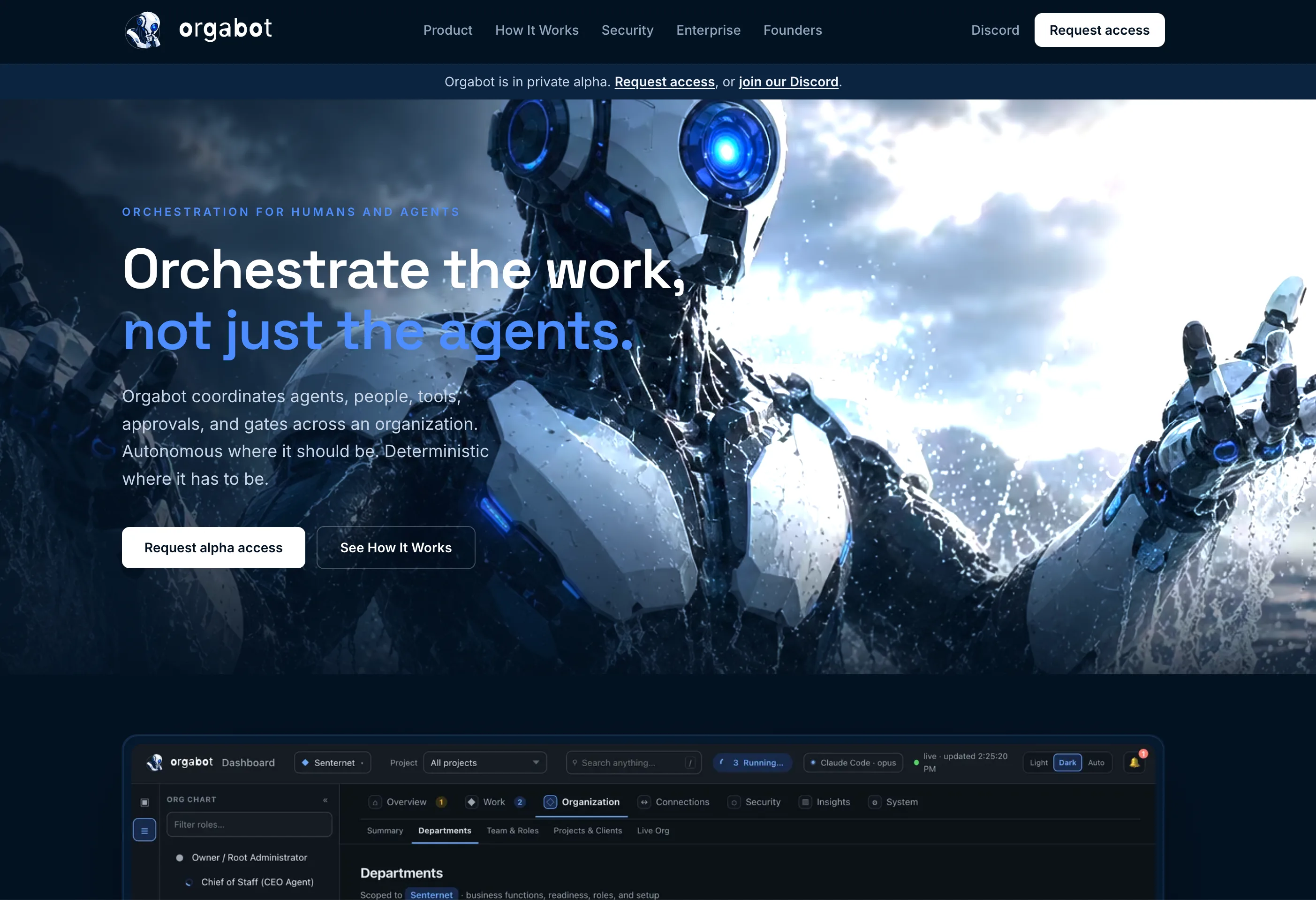
The problem
Agent work can be fast, but it becomes hard to trust when ownership, permissions, approvals, and the handoff back to people are unclear. Organizations need more than capable agents. They need a clear way to direct and govern the work those agents do.
What it does
Orgabot gives work a visible operating model: who is responsible, which tools an agent may use, when a person needs to decide, and what must happen before work can move forward.
- Coordinates work across people, agents, and connected tools
- Makes approvals and gates explicit instead of implicit
- Keeps organization-owned access and scoped roles visible
- Supports autonomy where it helps and deterministic controls where they matter
Built for accountable autonomy
The useful question is not whether an agent can complete a task alone. It is whether the organization can understand, guide, and trust how that task was completed. Orgabot is designed around that distinction.
What running work through Orgabot looks like
A piece of work arrives, from a tracker, a person, or another agent. Orgabot gives it an owner, a scope of tools it may touch, and the gates it has to clear before it can be called done. The agent works. When it reaches something that takes judgment, it stops and asks the named human instead of guessing.
The part that matters is the record left behind. Afterwards you can see what was decided and by whom or by what, which tools were used, and where a person stepped in. That is the difference between an agent that finished a task and an organization that can stand behind the result.
What Orgabot is not
It is not a chat interface with an agent in it. Excellent ones already exist, and the hard problem was never the conversation. It is everything around the conversation: permissions, ownership, approvals, and the handoff back to a person.
It is not trying to remove people from the loop either. The design assumes judgment is scarce and should be spent deliberately, so most of the product is about deciding where a human decision is genuinely required and making that moment explicit rather than implicit.