Why I Built StockCar
· Matt Senter
I wanted a podcast about my portfolio. Not the market. Not a stranger's high-conviction picks. The actual stocks, crypto, indices, and FX pairs I was holding that day.
Nothing like that existed. So I built it.
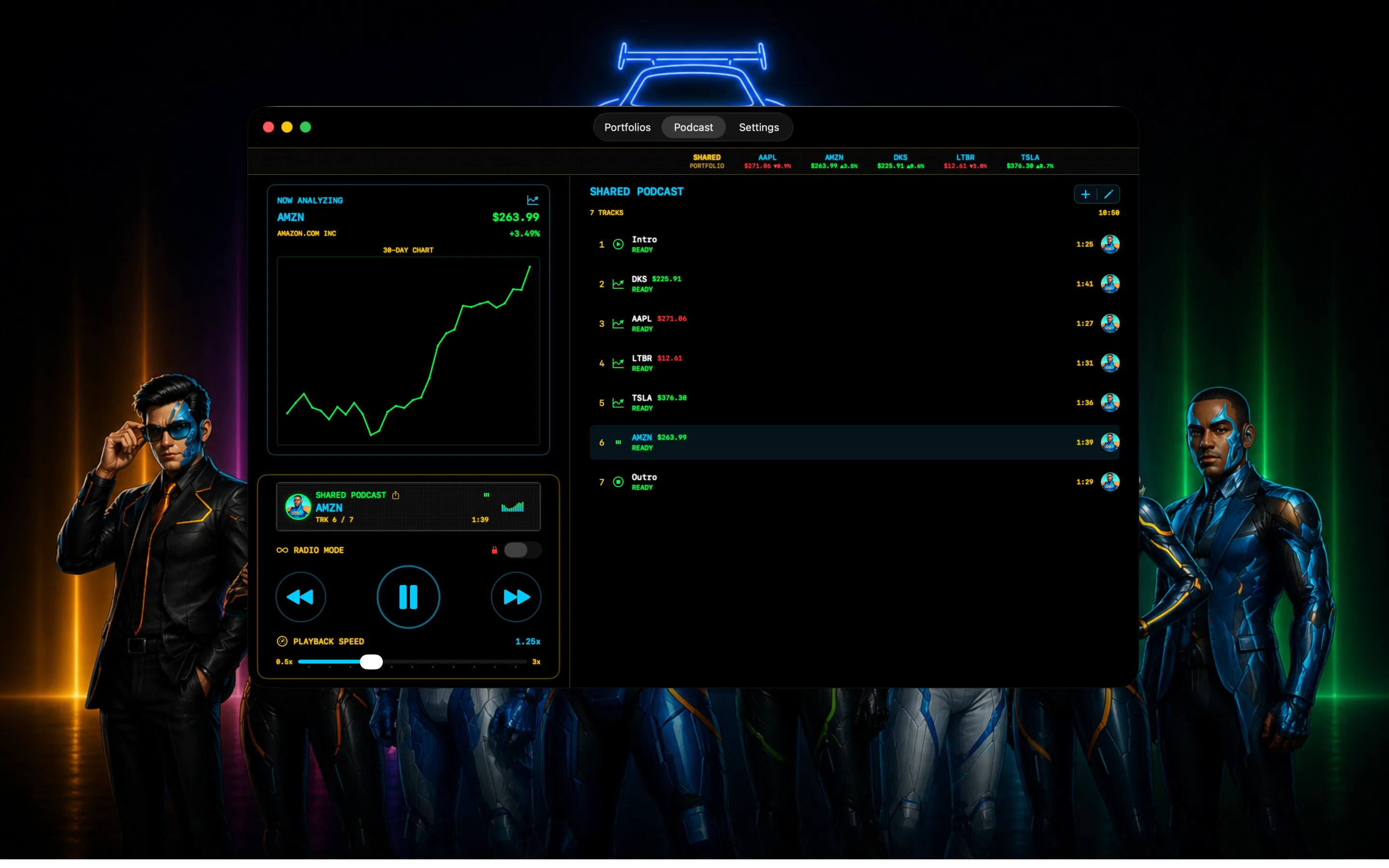
The thing I actually wanted
I'm an investor. I'm also someone who spends a lot of time not at a desk: commuting, running, lifting, cooking, walking the neighborhood. That's when I want to know what's happening with the things I own.
Charts don't help in any of those moments. Brokerage apps want my full attention. Even the financial podcasts I liked were talking about the wrong companies: the market at large, the analyst's favorites, the news cycle's loudest names. Nothing was about me.
What I wanted was simple: hit play, hear what moved in my portfolio, why it may have moved, and what's relevant before the next session. Then get on with the day.
Why couldn't this have existed three years ago?
Why this couldn't have existed three years ago. You couldn't build StockCar in 2022. Producing a fresh, personalized audio episode per user (written, narrated, mixed, delivered in under ten seconds) would have been absurd. The compute alone would have made it a luxury app for a hundred users.
The combination that made it possible:
- cheap, fast LLMs that can write a coherent script in seconds
- natural-sounding voice models that don't make listeners flinch
- real-time price and news APIs across asset classes
- mobile audio playback that handles long-form generated content well
Once those four things landed in the same year, the idea stopped feeling speculative and started feeling overdue.
The economics are the part I can point at. Stanford’s AI Index reports amore than 280-fold fall in the cost of querying a model at a given benchmark levelbetween November 2022 and October 2024. That is a stronger claim than saying nothing like this was possible.
The friction I refused to add
Most finance apps assume you're willing to create an account, link a brokerage, verify an email, and hand over personal data before you're allowed to see anything. I hate that pattern. I wasn't going to ship it.
StockCar's defaults are deliberate:
- no account required
- no brokerage linking
- your positions are never stored alongside anything that identifies you
- your tickers go to the model that writes your episode; anything I look at beyond that is aggregated and anonymized
- free on iOS, no paywall to listen
That list is the shape of it, but the privacy policy is the thing to actually trust. A bullet in a blog post is a summary; the policy is the commitment.
You add tickers, you hit play. That's it. The whole point of an audio app is that it should fit into a moment, not interrupt one with a signup flow.
Those defaults are written down rather than implied: theprivacy policysets out what is and is not kept, which is the document to hold me to.
Why it covers more than stocks
Almost no one I know has a portfolio that's only equities anymore. People hold a few stocks, some crypto, maybe an index, occasionally an FX position. The asset class lines have blurred for retail investors, but most apps still pretend they haven't.
StockCar treats it all as one feed. Stocks update before, during, and after the bell. Crypto updates twenty-four hours a day. Indices and FX show up alongside everything else. There's no "switch tabs to see the other half of your net worth" experience, because that experience is bad and I didn't want to build it.
The cohosts
One of the more fun decisions was building a cast of seven AI cohosts (Alpha, Andi, Arlo, Lana, Neo, Soos, Zoe), each with a distinct voice and personality. The Anchor, the Translator, the Analyst, the Operator, the Skeptic, the Quant, the Closer.
The reason this matters isn't novelty. It's that the right voice changes how an episode lands. A skeptical take on the same five tickers feels completely different from a quant breakdown of those tickers. Letting people pick their host turns the same data into a show they actually want to listen to.
What I learned shipping it
The hardest part wasn't the AI. It was making the audio feel like a show rather than a ticker read out loud. Pacing, transitions, when to skip a ticker that didn't move, when to lean into one that did, how to open, how to close. The technology is the easy part; the editorial sensibility is the work.
The second hardest part was restraint. There are a hundred features I could pile on. The whole premise depends on staying simple enough to use one-handed on a treadmill.
Where it's going
StockCar is live and free on iOS. Paid plans add Infinite Radio Mode™: continuous, refreshed updates throughout the day for people who want it on in the background like a real station.
I'm a user of my own app. I listen on the way to the gym most mornings. That has shaped more of the product than any roadmap document ever could.
If you want to try it, it's at stockcar.app. It takes about fifteen seconds to add tickers and hit play. You can also read the full StockCar project page for more on what it does and how it works.
← All postsNext: Teaching My Kids to Build Businesses With AI →