Why Every Youth Sports Team Needs a CPR and AED Plan
· Matt Senter
Youth sports leagues plan carefully for rain delays, field permits, and snack schedules. Far fewer plan for the moment a player collapses and does not get up.
Sudden cardiac arrest in young athletes is rare. When it does happen, what the adults and kids on the sideline do in the next few minutes largely decides the outcome. That is why I think youth sports CPR and AED readiness belongs in the same category as the first aid kit: expected, not optional, and not someone else’s job.
I co-founded BeeReady, a nonprofit that builds CPR, AED awareness, and emergency confidence into youth sports. This is the case for why that readiness belongs at every field and gym.
How serious is sudden cardiac arrest in young athletes?
A 2023 review in Clinical Cardiology describes sudden cardiac arrest as the leading medical cause of death in athletes, and notes that it can strike regardless of age or conditioning. The Korey Stringer Institute calls sudden cardiac death the number one cause of exercise-related death in young athletes.
Looking beyond athletes, the CDC estimates that approximately 23,000 sudden cardiac arrests occur in children every year.
Most parents will never see one on a field. That rarity is the real problem. A league can go years without an emergency, and the plan, the training, and the AED battery all quietly lapse while nobody is looking.
Why do the first few minutes decide the outcome?
Sudden cardiac arrest is not a heart attack. As the CDC explains, it happens when the heart suddenly and unexpectedly stops beating, and it can lead to death.
What happens next matters enormously. According to the CDC, bystander CPR can double or triple the odds of survival from an out-of-hospital cardiac arrest. Speed of defibrillation matters just as much: the Clinical Cardiology review cites research in which 74% of patients in a shockable rhythm survived when they were defibrillated within 3 minutes, compared with 49% when it took longer.
That window is measured in minutes. The people who matter most are the ones already standing there: coaches, parents, volunteers, and teammates, long before anyone with medical training arrives.
Why is practice the riskiest place to be unprepared?
A 2025 study in the Journal of the American College of Cardiology tracked sudden cardiac arrest in U.S. competitive athletes aged 11 and older from 2014 to 2023. The good news is that survival improved over that period.
The finding that stuck with me is about where it happens. Among arrests during exertion, 70% of athletes survived when they collapsed during a game, compared with 53% at practice or training. The authors call for emergency preparedness and AED access at every facility used for practice, “not just venues for games.”
That makes sense to anyone who has spent time around youth sports. Games draw crowds, officials, and sometimes an athletic trainer. A weeknight practice is often one coach, a few parents, and a lot of kids.
Who on a youth sports team should know CPR?
The short answer is everyone who is regularly there. An Inter-Association Task Force consensus statement recommends that coaches for every team receive certified CPR and AED training, and that every program keep a written emergency action plan that is reviewed and practiced at least once a year.
Youth programs often fall short of that. The Clinical Cardiology review cites a survey of Amateur Athletic Union youth basketball clubs in which only 35% required CPR training for coaches and just 6% had a written emergency action plan.
- Coaches, who are usually the adult in charge when something goes wrong.
- Parents and volunteers, who fill most of the sideline at practices and games.
- Teammates, who are often the first to reach a player who goes down.
- Facility staff, who know where the AED is kept and how to get to it.
Kids belong on that list. They are already at every practice, and learning with their own team in a place they know is what makes the skill stick.
Where is the AED at your field or gym?
An AED only helps if someone can get it to the player quickly. The CDC recommends placing AEDs so they are always accessible, clearly marked, and available for use within 3 to 5 minutes. The task force sets a goal of less than 3 to 5 minutes from collapse to first shock.
Before the season starts, every league should be able to answer a few questions:
- Is there an AED at this field, and is the building it lives in unlocked during practice?
- Can someone get from the farthest field to the AED and back inside that window?
- Is someone responsible for checking it, including the battery and the pad expiration dates?
- Does every coach know exactly where it is?
The CDC also recommends running drills at least once a year to build confidence, strengthen communication, and improve the coordinated response. A plan that nobody has rehearsed is a plan people will be reading for the first time during an emergency.
What does a prepared youth sports program look like?
It is not complicated. A written emergency action plan for each venue. At least one adult with current CPR and AED certification at every practice and game. An AED within reach that everyone can find. A drill each season.
The training itself should come from a certified course, not a blog post. The American Red Cross and the American Heart Association both offer CPR and AED classes for coaches, parents, and volunteers.
How does BeeReady help youth sports leagues?
BeeReady is the physician-led nonprofit I co-founded with my wife, Dr. Andi Senter, and Dr. Elda Fisher, to make this normal in youth sports around Durham and the Triangle. Training is taught to the American Red Cross standard.
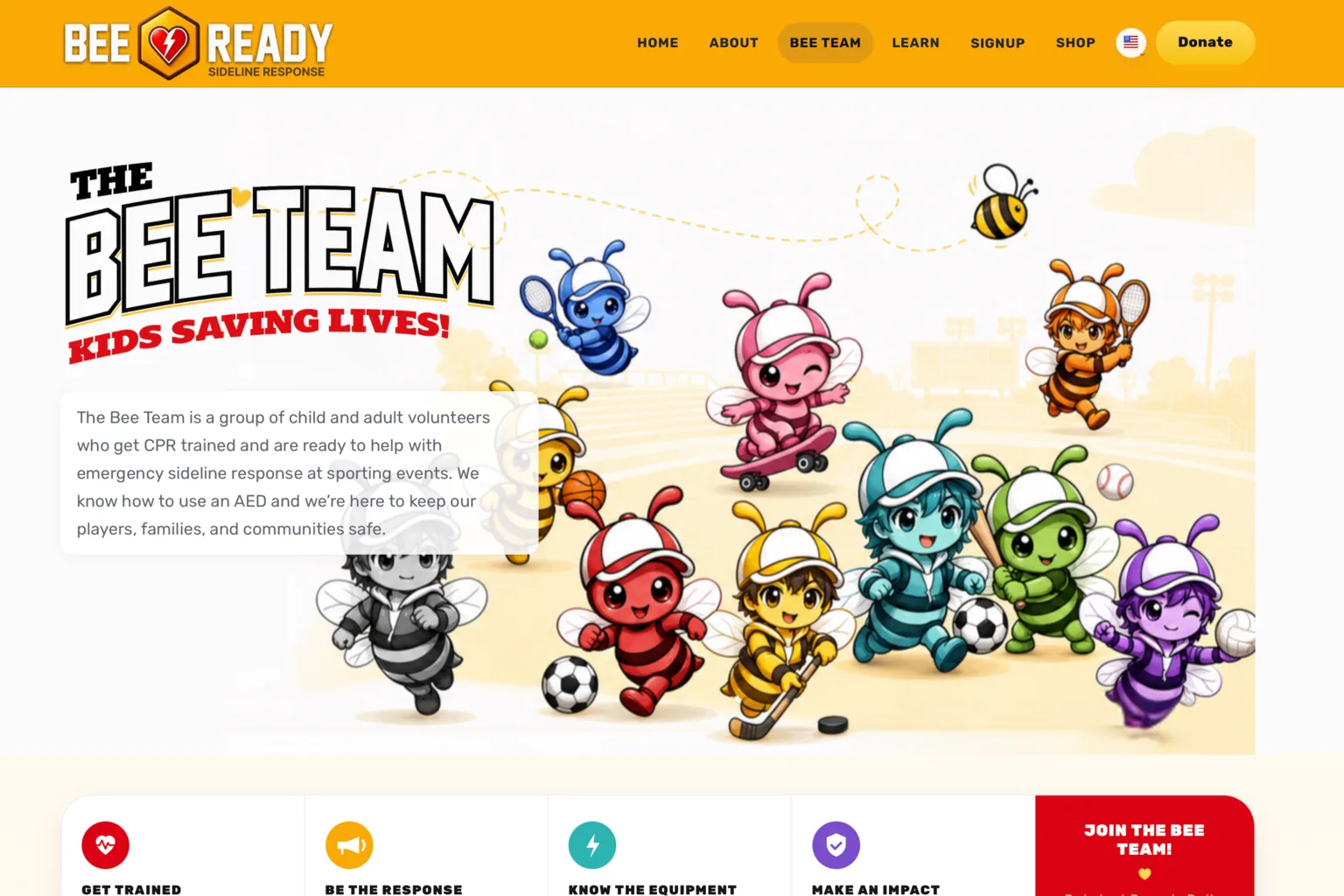
Leagues can host a BeeReady Day, where trained volunteers bring an AED to the sideline for the duration. Coaches, parents, and volunteers can get certified. Young athletes can join the Bee Team and learn CPR basics alongside the adults. We also help leagues figure out what AED coverage their fields need, where it should live, and how to fund it.
Our services are free to leagues, because the mission only works if cost is never the reason a team says no. That is also why we built BeeReady as a nonprofit rather than a company.
Youth sports already gather the right people every week, for a season, for years. That makes a team one of the best places I know to build a skill that has to be ready on the worst day. If you run a league, tell BeeReady about it.