SeedMatrix
SeedMatrix aggregates independent variety trial data across crops, regions, soils, and traits, so seed companies can prove where a variety actually performs instead of arguing from anecdote.
It is the platform I originally co-founded in 2008. Today I work on it through Senternet, rebuilding the engine that turns 1.8 million trial data points into a comparison a grower can trust.
Visit seedmatrix.com ↗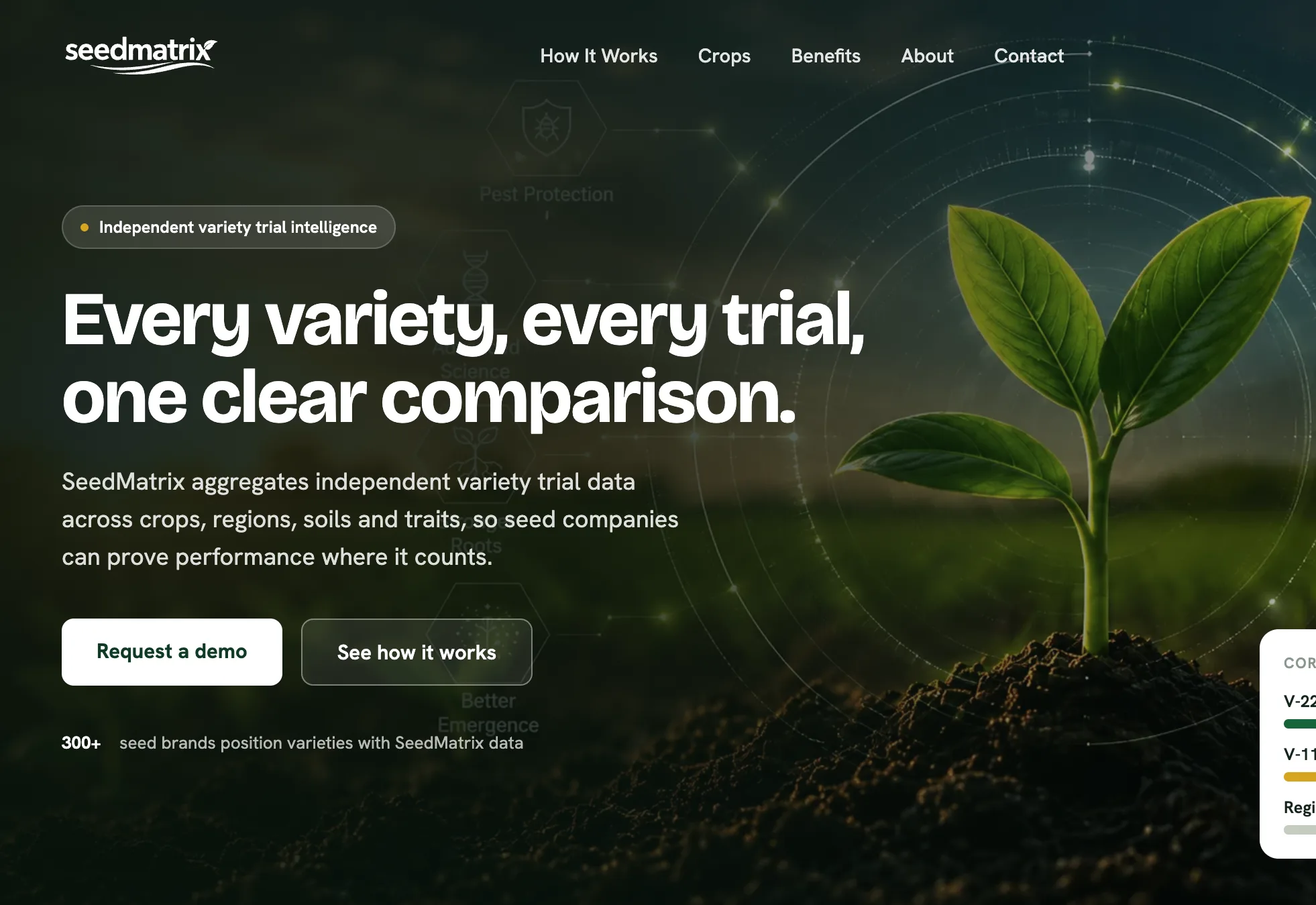
The problem
A seed brand can tell a grower its variety yields well. Proving it in that grower’s county, on that soil, under that irrigation, against the variety they planted last year is a different problem entirely, and the data lives scattered across dozens of independent trial networks.
What it does
SeedMatrix pulls official variety trial data together with a company’s own internal plot data, then lets a sales team slice it down to the conditions that match the field in front of them. Every data point ties back to a named, dated independent trial.
- Head-to-head, top-performer, and one-against-many comparisons
- Filter by region, soil texture, irrigation, maturity, and technology traits
- Geographic maps of variety strengths and weaknesses
- Branded one-pagers and Excel exports for the field
- Per-account permissions over who sees which data
Why it matters
Seed is a high-trust purchase made once a year with a whole season riding on it. Independent, sourced, defensible data is the only argument that survives contact with a skeptical grower. SeedMatrix exists to make that argument fast enough to have in a truck cab.
The conversation this has to survive
A seed rep is in a truck cab with a grower who planted a competitor variety last year and was happy with it. The rep has five minutes and a tablet. The grower wants to know how the new variety did on his soil type, under his irrigation, in his maturity group, near his county, against the exact variety already in the ground.
That is the only question that matters, and it is the one a glossy yield brochure cannot answer. SeedMatrix exists to make that comparison fast enough to pull up during the conversation, with every number traceable to a named, dated, independent trial the grower can go verify.
Coming back to it eighteen years later
I co-founded SeedMatrix in 2008, and it was acquired by Context Network. Today I work on it again through Senternet, rebuilding the engine underneath it. Returning to a problem after eighteen years is a strange experience: the domain has not changed much, and almost everything about how you would build the software has.
What has not changed is the hard part, which was never the querying. It is reconciling trial data from dozens of independent networks that each name crops, traits, and locations differently, and doing it without quietly inventing precision that the underlying data does not support.
What it does not do
It does not predict yield. It reports what independently measured trials actually observed, filtered to the conditions you care about. A model that guesses at a number would be more impressive in a demo and worth less in the truck cab, because the moment a grower catches one prediction being wrong the whole tool is finished.
It also does not blend a company’s internal plot data into the independent numbers without saying so. Which trials are independent and which are the seller’s own is always visible, because that distinction is the reason the comparison is persuasive at all.