I’m Trying to Talk Myself Out of Buying a Mac Studio. Apple Isn’t Helping.
· Matt Senter
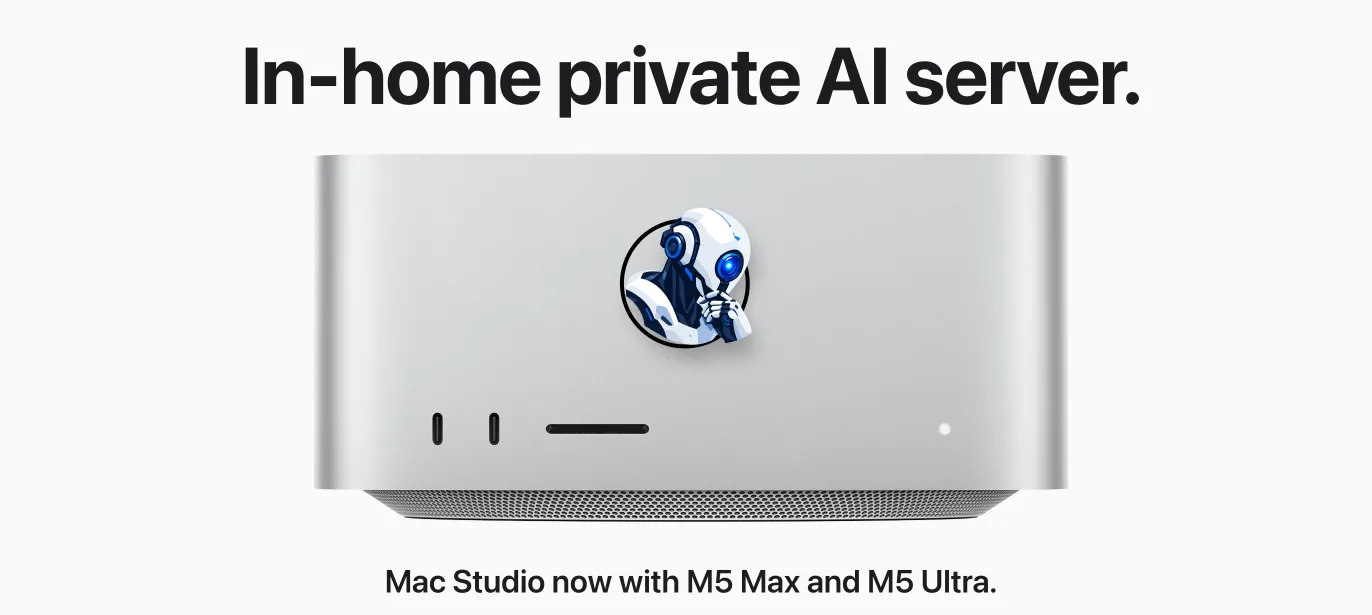
I’m trying to convince myself that I do not need a fully loaded Mac Studio.
It is not going well.
Apple’s new Mac Studio is a ridiculous desktop: up to 512GB of unified memory and 1.2 TB/s of memory bandwidth. More importantly, Apple is explicitly presenting it as an on-device AI machine, capable of running large open-weight models locally. Apple says as much.
I absolutely do not need this computer. Probably. The problem is that machines like this are starting to look less like desktops and more like privately owned AI infrastructure that happens to sit on a desk.
Apple is practically advertising a private AI server
Apple is not being subtle about where it thinks this goes. Its Mac mini announcement describes the machine as suitable for always-on, deskside agentic computing. The Mac Studio takes that idea much further: huge unified memory, high bandwidth, and the ability to cluster machines over Thunderbolt 5 for very large local workloads. That is Apple’s framing, not mine.
Unified memory is the unusually interesting part. On Apple Silicon, the CPU and GPU draw from one shared memory pool instead of shuffling work between system memory and separate GPU VRAM. Apple’s open-source MLX framework is designed around that architecture.
This does not magically make a Mac Studio equivalent to a data center full of NVIDIA hardware. But it does make hundreds of gigabytes of GPU-accessible memory possible in a quiet personal computer. That changes the category of work the machine can plausibly handle at home.
Should AI run locally, or in the cloud?
The interesting architecture is local-first, not local-only. The thesis is not that a Mac Studio replaces OpenAI, Anthropic, or Google. The frontier labs will continue to have more compute, faster release cycles, and better models for plenty of difficult work.
The more interesting idea is a private local intelligence layer that handles everyday work, keeps sensitive context home, and escalates only the hardest problems to a frontier model.
An orchestrator should not merely ask which model is smartest. It should consider whether a task is sensitive, how difficult it appears, whether it needs code or vision, how quickly it needs an answer, what an external call costs, and whether a local model is good enough.
Orgabot is the clearest example
I already run several products where AI is central to the architecture: Orgabot, Premail, and Highwire. Orgabot is the most obvious candidate because an orchestration system should not be married to one model.
                         ORGABOT
                            |
          +-----------------+------------------+
          |                 |                  |
          v                 v                  v
      FAST LOCAL       SPECIALIST LOCAL    FRONTIER CLOUD
       MODELS               MODELS              MODELS
          |                 |                  |
     classification      coding             GPT
     extraction          vision             Claude
     summarization       images             Gemini
     embeddings          speech             etc.
          |                 |
          +--------+--------+
                   |
             PRIVATE DATA
             STAYS LOCAL
A small local model can classify, extract, summarize, route, and create embeddings. A stronger local coding model can handle ordinary software work. Other local models can specialize in vision, speech, or image generation. A genuinely difficult task can be escalated to whichever frontier model is strongest at the time.
That makes model choice infrastructure instead of a recurring user decision. It also makes the cloud a specialist rather than the default employee.
Premail makes the privacy case
Premail is already BYOK and privacy-first. It can use the provider and model a person chooses, including local models served through Ollama. A powerful always-on Mac would make that design much more compelling.
Email could be indexed locally, embedded locally, classified locally, summarized locally, and processed by a model running a few feet away. Routine drafts and analysis would not have to leave the house at all.
That matters because an inbox contains financial records, health information, family conversations, account data, contracts, receipts, attachments, and years of personal history. The more context an AI email assistant has, the more useful it becomes, but the more consequential it is to transmit that context elsewhere.
With a local-first design, the default reverses. The raw mailbox stays home. A frontier model can still help when it is warranted, but only with the minimum context necessary.
Highwire could move expensive inference into my house
Highwire relies on AI to ingest news, group articles into stories and narratives, analyze framing and evidence, and generate summaries before readers see the result. It is natural to assume all of that work belongs in the cloud because the public website does.
Those two things do not actually have to be coupled.
Internet sources
      |
      v
Private AI infrastructure
in my house
      |
      | analysis, classification, embeddings, summarization
      v
Finished structured result
      |
      v
Cloud production environment
      |
      v
highwire.news
The public site needs reliable hosting, storage, networking, and distribution. That does not mean every expensive inference job must run in a cloud data center. A local worker could perform much of the analysis, then publish structured results to production.
There are real tradeoffs: queues, retries, remote administration, monitoring, backups, and a graceful cloud fallback. But this is not the same as hosting a public website from my house. A processing job running ten minutes late is usually survivable.
Local coding is already remarkably good
One of the most interesting local coding candidates is Qwen3-Coder. The family is designed for agentic coding and tool-driven workflows, which is precisely the kind of work I could imagine Orgabot assigning to a local model.
It does not need to replace the best cloud model on every task. It needs to handle a large share of routine work without sending a repository to someone else’s infrastructure or charging for every token generated.
The caveat is important. Local models can lag the frontier in release cadence, long-horizon reasoning, tool use, and recovery from difficult failures. I would not want to be fully offline when a problem is ambiguous, architectural, or unusually stubborn.
That is an argument for escalation, not an argument against local models.
The frontier should become an escalation path
Most AI work does not require the smartest model humanity has produced. I do not need the latest frontier model to determine whether an email is a receipt, extract a date, create an embedding, summarize a Git diff, classify a news article, transcribe audio, inspect a straightforward log file, or make hundreds of small decisions during a day.
Task arrives
    |
    v
Can a local model handle it confidently?
    |
   YES ------------------> Run locally
    |
    NO
    v
Does it contain sensitive information?
    |
   YES
    |
    v
Reduce, sanitize, or preprocess locally
    |
    v
Send minimum necessary context
    |
    v
Frontier model
When Orgabot encounters the race condition that has survived three attempts at a fix, needs to reason through a major migration, or simply has low confidence, it can call the frontier model. That is a much more realistic future than pretending every machine should be independent of the cloud.
Privacy may be the strongest reason to do this
Apple has invested heavily in privacy-preserving cloud inference through Private Cloud Compute. The engineering is impressive. But there is still an architectural difference between building a more private cloud and never sending sensitive data to the cloud in the first place.
The most private cloud inference request is the one I never make.
That applies to Premail, but also to source code, internal business documents, unreleased products, personal files, credentials, and the large amount of context an autonomous system can accumulate. Local AI reduces the number of parties I have to trust.
It does not eliminate risk. A local machine still needs patching, encryption, backups, isolation, and monitoring. But removing an external network request removes an entire category of exposure.
Does a local AI machine actually pay for itself?
The economics get weird surprisingly fast. For someone who occasionally asks a chatbot questions, buying expensive local AI hardware makes little economic sense. Cloud subscriptions are convenient and someone else maintains the GPUs.
Agentic workloads change the equation. A system continuously inspecting repositories, reading logs, evaluating tasks, summarizing information, monitoring systems, and deciding what to do next can consume an enormous number of tokens. A local model moves the marginal cost of another request closer to electricity.
It is still not free. Buying a Mac Studio prepays for compute through capital cost, power, depreciation, storage, maintenance, and eventual replacement. For occasional requests, cloud APIs probably win. For an orchestrator making thousands of decisions continuously, owning some inference starts looking much more interesting.
I probably do not need the 512GB model
This is where I am still attempting restraint. A 512GB Mac Studio is an almost comical amount of memory for a personal computer, but most of the workloads I am describing do not require it.
The rational version of this experiment is probably a 128GB or 256GB machine with a carefully chosen set of models. The irrational version is 512GB because someday I might want to see what enormous model I can fit into it.
I am unfortunately aware of which version of myself usually wins these debates.
Apple has not been helpful
For the first few years of generative AI, we rented intelligence from somebody else’s data center. Machines like the Mac Studio suggest a different future: own enough intelligence locally to handle everyday work, and rent frontier intelligence only when you actually need it.
If I think of the Mac Studio as a powerful desktop computer, buying a maxed-out one seems ridiculous. If I think of it as infrastructure that can run Orgabot continuously, privately process Premail data, generate images, transcribe audio, operate coding agents, help produce Highwire, and selectively call frontier models when necessary, the calculation looks different.
Which is unfortunate. I started researching this specifically to give myself reasons not to buy one.
← All postsNext: Microsoft’s Account Recovery Is Security Theater →