The One Place I Wouldn’t Replace Humans With AI Is Customer Care
AI can automate customer service. It should not stand between a frustrated customer and a human being.
· Matt Senter
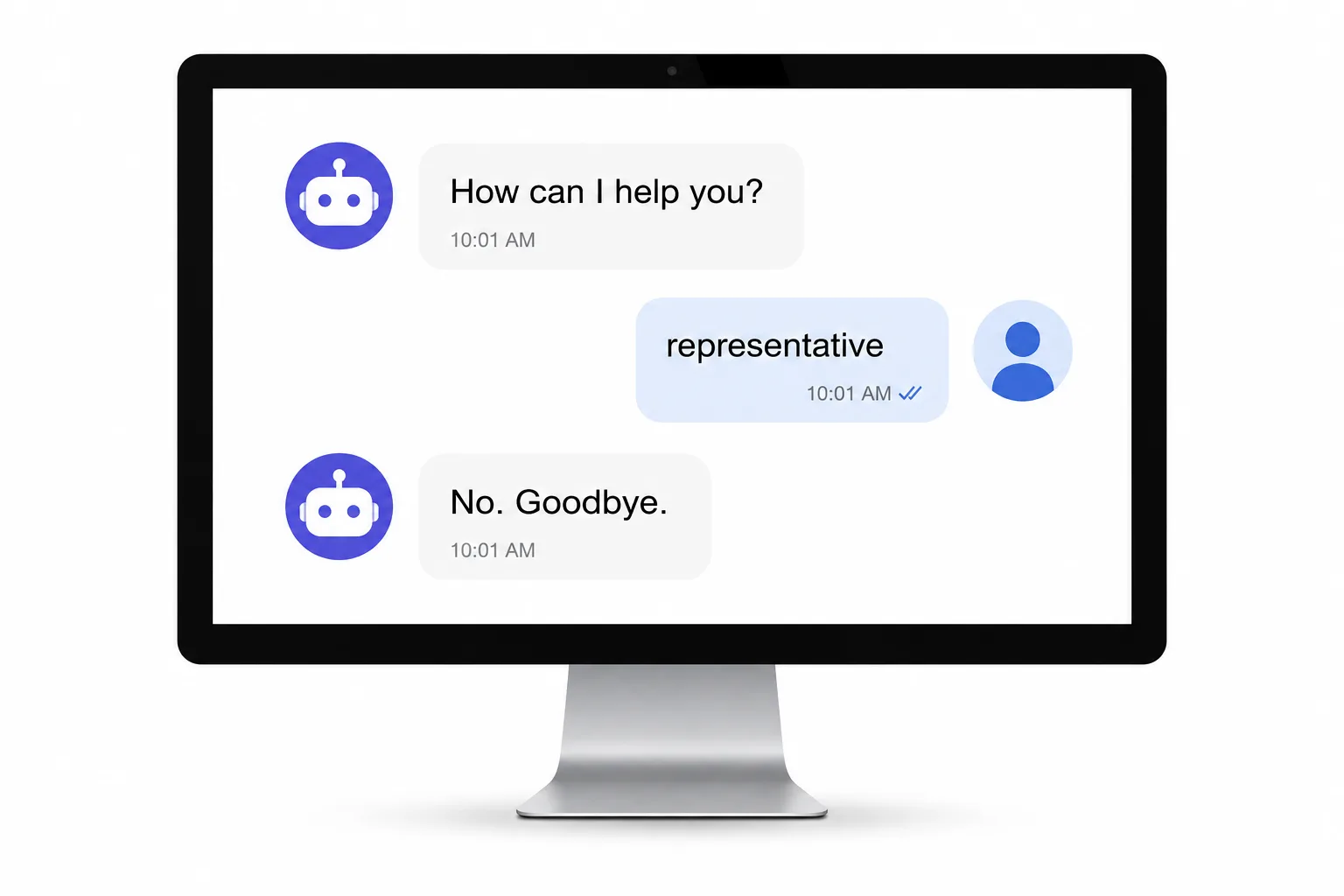
AI agents are getting good enough that I increasingly find myself asking the opposite of the question most companies ask. Instead of, “What can we automate with AI?” I ask, “What still deserves a human?”
For me, customer care is near the top of that list.
Companies have been trying to automate customer support for decades. Phone trees, scripted chatbots, knowledge bases, decision trees, self-service portals. The pitch has always been the same: solve simple problems faster, reduce support costs, and keep people from waiting on hold.
Sometimes that works. If I want to check an account balance, track an order, reset a password, or perform some other obvious transaction, automation is great. AI can make those interactions even better.
But that is usually not why I am trying to reach customer support. Most of the time, I am contacting support because all the easy automated options have already failed. That is the part companies seem to miss.
By the Time I Call, Something Has Already Gone Wrong
A customer who has reached the point of calling support is often already frustrated. Maybe:
- The website does not work.
- The account is locked.
- The product behaves differently than expected.
- The documentation is wrong.
- The customer has a weird edge case nobody anticipated.
Whatever the reason, the normal path failed. And increasingly, the company's response is to put another automated system in the way.
That does not feel like customer care. It feels like customer avoidance.
I recently had to call Microsoft support about an account issue. Their AI phone system simply refused to let me speak to a human. That would have been frustrating enough on its own, but the system also repeatedly failed to understand basic words like “billing.” I would say what I needed, and it would respond with some variation of, “I’m sorry, I’m having trouble hearing you.”
This was not a chatbot where I could rephrase the question, paste in an error message, or try a different route. It was a phone system controlling access to support. The AI was not solving my problem. It was preventing me from reaching someone who might.
Best Buy Was Even Worse
I had a similar experience with Best Buy. I wanted to know whether my local Geek Squad could repair a Meta Quest 3. Before driving to the store, I did what seemed reasonable: I called.
The AI phone system assured me that yes, Geek Squad could repair it. I did not entirely trust that answer, so I asked to speak with a human.
Instead of reaching the local store, I got a national call center. The person there told me they did not know whether my local Geek Squad handled Meta Quest repairs. They gave me a special extension that was supposedly a way to reach the store directly.
So I called back, used the extension, and spoke to someone who appeared to be at the store, which they named by location. They told me yes, they repaired Meta Quest 3 devices. They even said they checked with another team member. They booked me an appointment for the next day.
I showed up. The Geek Squad employee told me no. Absolutely not. They do not repair Meta Quest 3 devices.
Another employee explained that I probably had not reached the store at all. The AI phone system, he said, was awful (even he hated it!) and routinely routed customers to national support people who did not actually know what was happening inside individual stores.
I told him I had used the secret extension I had been given specifically to reach the store. His curt response was: no, you still did not reach us.
Think about that interaction. The automated system gave me bad information. The first human I reached could not answer the question. I was given a workaround for the automation. The workaround apparently routed me somewhere else anyway. That person gave me more bad information. I made an unnecessary appointment, drove to the store, and only then got the correct answer.
AI did not make customer support more efficient. It made the entire system less trustworthy.
The Problem Is Not That AI Is Bad at Talking
This is not really a criticism of modern language models. The newest AI systems can hold remarkably natural conversations. They can understand messy questions, summarize complicated situations, search documentation, classify issues, and often reason through problems better than old scripted customer-service bots ever could.
The problem is not that the AI sounds robotic (although the patronizing tone is definitely a turnoff). The problem is what companies are asking it to do.
Too often, the goal appears to be preventing the customer from reaching a human. That incentive existed long before modern AI:
- Automated phone systems were designed around call deflection.
- Chatbots were designed to reduce ticket volume.
- Help centers were designed to make customers solve their own problems.
Generative AI simply makes that strategy more powerful. A bad phone tree could block you with five menus. An AI system can block you indefinitely while sounding helpful the entire time.
That is not progress.
What does it mean when a customer asks for a human?
There should be a very simple rule for AI customer support: If the customer asks for a human, give them one. Immediately.
The Customer Asking for a Human Is Giving You Useful Information. That request is itself valuable information. The customer is telling you that the automated path is not working for them.
Maybe the AI could theoretically solve the problem if the customer phrased it differently. Maybe the customer overlooked something obvious. Maybe another minute of conversation would have produced the right answer. It does not matter.
At that point, continuing to force automation on the customer is optimizing for the company's support costs instead of the customer's experience. The agent had its chance. The escalation request is the signal that it is time to hand off.
Use AI to Make Customer Care Better
I am not arguing that AI has no place in customer support. Quite the opposite. Customer support may be one of the best places to deploy AI, as long as the AI is helping the people providing support rather than replacing access to them.
Imagine a customer-care representative who starts every call with an AI-generated summary of the customer's account, previous support conversations, recent purchases, open issues, relevant policies, and likely solutions. Behind the scenes, AI could:
- Search internal documentation in seconds.
- Summarize a twenty-message support history.
- Surface the exact warranty or policy that applies.
- Draft follow-up notes and categorize the interaction.
- Prepare a refund or other routine account action.
- Identify the right escalation team.
- Handle the tedious administrative work that consumes a representative's time.
That is an excellent use of AI. The customer gets a human being with dramatically better tools. The employee gets to spend more time actually helping people. And the company still gets much of the efficiency AI promises.
That seems far more valuable than building an increasingly sophisticated robot whose primary job is making it difficult to reach anyone.
There is evidence for this shape of it. Ina study of 5,172 support agents, AI assistance raised issues resolved per hour by about 15% on average, with the largest gains for the least experienced staff. The human stayed in the loop. TheCFPB has separately documentedwhat happens when they do not: repetitive dead ends and no way through to a person.
Is customer care just a cost center?
Customer Care Is Not Just a Cost Center. I understand why companies are tempted. Customer support is expensive. Large companies employ thousands of people whose jobs involve answering repetitive questions. If AI can handle a meaningful percentage of those interactions for a fraction of the cost, the spreadsheet is extremely compelling.
But customer care is not an ordinary operational expense. It is where customers go when something has gone wrong:
- The product failed.
- The billing went wrong.
- The account broke.
- The customer is confused.
- The normal process did not work.
That means the support interaction often happens at one of the most important moments in the relationship between a company and its customer. At that exact moment, the company has an opportunity to either repair the relationship or make the situation worse.
Reducing the labor cost of that interaction while dramatically increasing customer frustration is not necessarily efficiency. Sometimes it is just moving a number from one spreadsheet column to another.
Some Human Jobs Are Worth Preserving
We are entering an era where AI agents will perform an extraordinary amount of work. I am excited about that. I build with these systems constantly.
In fact, one of the things I am building, Orgabot, is intentionally ambitious about this. Its goal is to make an AI agent organization a drop-in replacement for large parts of an org chart, with specialized agents performing jobs, collaborating, and moving work through controlled workflows. I clearly do not have a philosophical objection to replacing human work with agents when the agents can do the job well.
That makes it even more important to identify the places where removing the human makes the product worse.
Customer care looks like low-hanging fruit for AI replacement because so much of the work appears repetitive. I think that is exactly the wrong way to look at it.
Automate:
- The account lookup.
- The documentation search.
- The forms.
- The summaries.
- The routing.
- The follow-up.
- Every repetitive piece of work around the interaction that AI can do better.
But when a frustrated customer says, “I need to talk to someone,” let them talk to someone.
Sometimes the human being is not the inefficiency in the system.
Sometimes the human being is the entire point.